




Some dogs cope well with time alone. Others become restless, vocal, or destructive once they’re on their own. The tricky part is that separation anxiety in dogs can show up in ways that are easy to miss, particularly when nobody is around to see what’s happening.
A chewed cushion or a scratched door doesn’t automatically mean separation anxiety. Your dog could be bored, reacting to something outside, or simply looking for something to do. There can be several explanations for the same behavior.
That’s why watching what your dog actually does while you’re away can be so useful. It gives you a much better idea of what’s going on instead of having to guess from the evidence you find when you get home.
What Separation Anxiety in Dogs Really Looks Like
Dog separation anxiety is more than simply missing your owner. It involves significant distress when the dog is separated from the person or people it’s attached to.
Some dogs show obvious signs almost immediately after their owner leaves. Others may seem fine at first and become unsettled later.
Common separation anxiety signs can include:
- Persistent barking, whining, or howling
- Pacing or repeatedly walking the same route
- Scratching or chewing at doors and windows
- Destructive behavior
- Indoor accidents despite being house-trained
- Attempts to escape
- Excessive drooling or panting
- Restlessness or an inability to settle
Not every dog will show all of these behaviors. Seeing one doesn’t automatically mean your dog has separation anxiety.
Context matters.
For example, a dog who barks whenever someone walks past the window may simply be reacting to outside activity. A dog that starts barking, pacing, and scratching at the door within minutes of being left alone shows a very different pattern.

Why You Might Not Know It’s Happening
Here’s the frustrating part: you aren’t there when most of these behaviors happen.
Your dog may look relaxed when you’re getting ready to leave. They may even happily accept a treat, curl up in their favorite spot, and seem completely fine as you walk out.
Then something changes once you’re gone.
Research into separation-related problems has found that behaviors can vary considerably between individual dogs, with vocalization, destruction, restlessness, and other signs appearing in different combinations.
That means your dog’s behavior while alone may tell you something you can’t see when you’re at home.
💡 Did you know?
In a large study of 2,757 dogs presenting with separation-related problems, researchers found several different behavior patterns rather than a single presentation. Vocalization, destruction, house soiling, and signs of sadness or distress could appear alone or together.
A Camera Can Show You What Happens After You Leave
This is where a pet camera for separation anxiety can be useful. Not because the camera fixes the problem. It doesn’t.
Its real value is much simpler: it lets you see what your dog does when you’re not there to see it yourself.
You might discover that your dog falls asleep ten minutes after you leave. That’s useful information.
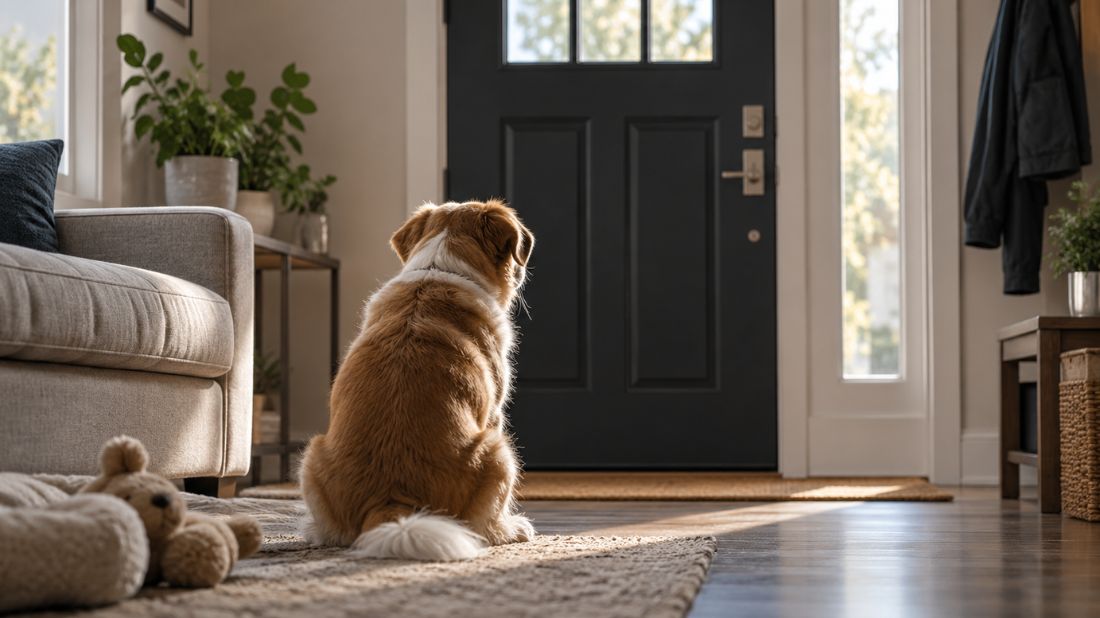
Or you might notice a completely different pattern. Your dog may pace around the room, stare at the front door, bark at intervals, or become increasingly restless.
You can also pay attention to timing.
Does the behavior start immediately? Five minutes later? Only after an hour? Does your dog eventually settle down, or does the behavior continue?
Those details can give you a much clearer picture of the situation.
Look for Patterns, Not One Bad Day
One stressful afternoon doesn’t necessarily tell you what’s going on.
Maybe there was construction outside. A thunderstorm rolled through. Someone rang the doorbell repeatedly. Your dog wasn’t feeling well.
That’s why it helps to look at several monitoring sessions rather than focus on one unusual incident.
Keep an eye out for patterns such as:
| What you notice 👀 | What it may tell you ℹ️ |
|---|---|
| Your dog sleeps soon after you leave | They may be comfortable settling down alone |
| Barking starts when people pass outside | The behavior may be linked to an outside trigger |
| Pacing starts within minutes of departure | Separation-related distress may be worth investigating |
| Destruction happens only when you’re gone | The timing and context are important clues |
| Your dog stays calm but becomes restless later | The behavior may develop after a period of alone time |
The goal isn’t to diagnose your dog from a camera. It’s to gather useful information.
Can a Pet Camera Actually Help With Separation Anxiety?
A pet camera can’t treat anxiety, and it can’t tell you with certainty why your dog is behaving a certain way.
What it can do is help you observe the behavior in the environment where it occurs.
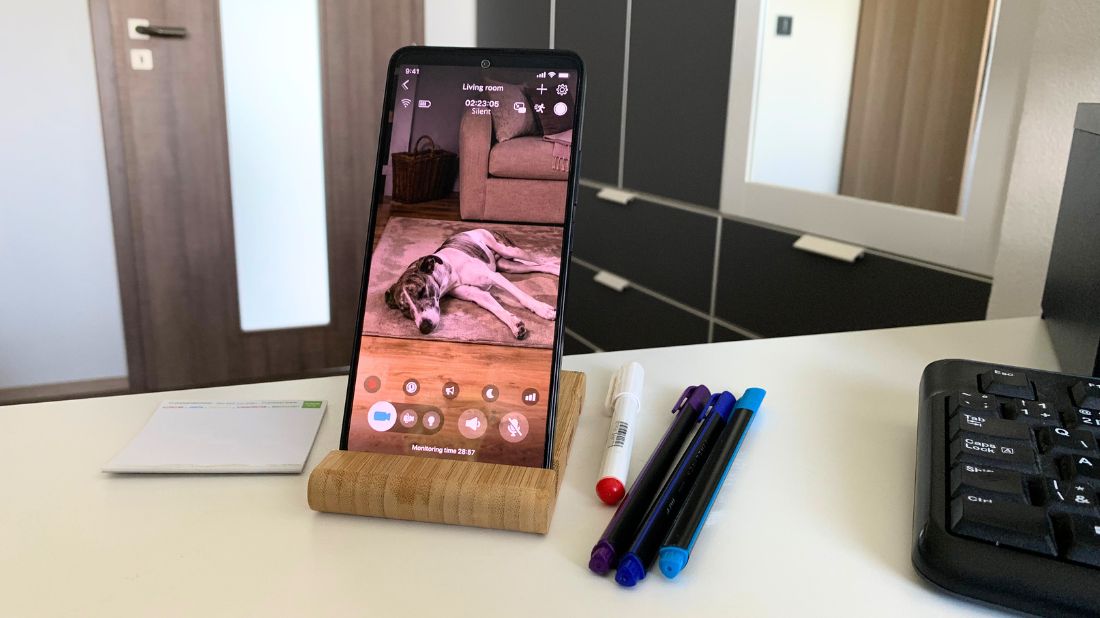
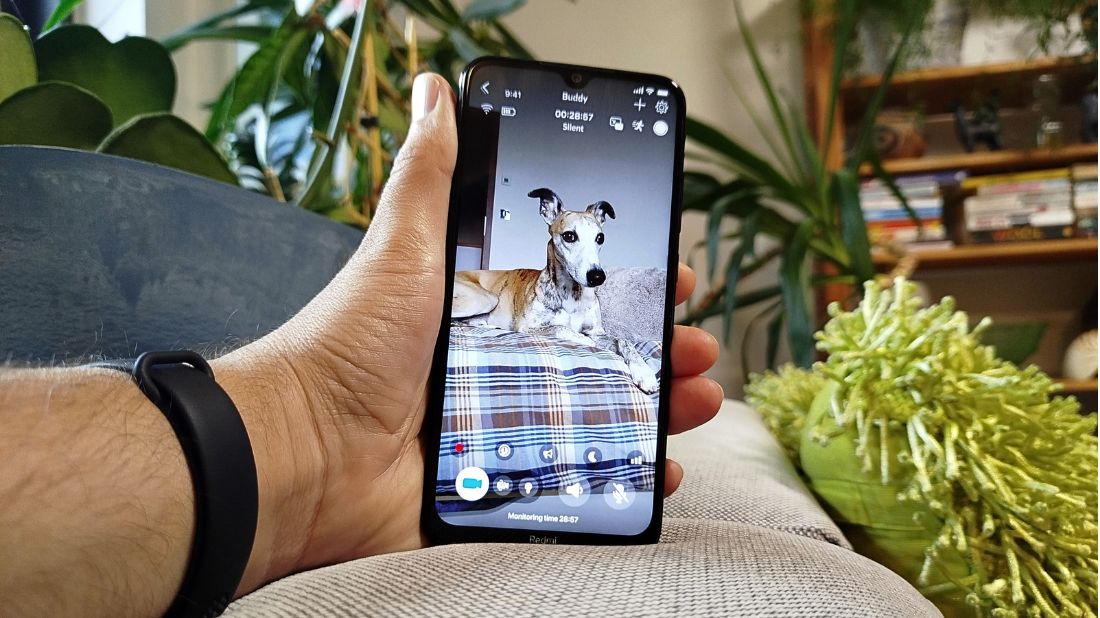
With the Buddy Dog Monitor app, for example, you can use two compatible smartphones or tablets to watch your dog remotely. One device stays with your dog, while the other stays with you. Live video lets you see what’s happening, while two-way audio and motion and noise detection can give you additional context.
That can be especially useful when you’re trying to work out a pattern.
Perhaps your dog settles down after 15 minutes. Maybe they bark only when they hear activity outside. Perhaps they never touch the food toy you leave for them because they become too unsettled once you’re gone.
These observations can help you make better decisions about what to do next.
💡 Did you know?
Separation-related behavior often appears soon after the owner leaves, according to veterinary behavior guidance. That’s one reason the first few minutes of a monitoring session can be particularly useful when you’re trying to understand your dog’s routine.
What Should You Do If You See Concerning Behavior?
If monitoring shows that your dog is repeatedly distressed when left alone, don’t jump straight into punishment or assume they’re simply being difficult.
Anxious behavior isn’t bad behavior in the traditional sense. Your dog may be struggling with a situation they find genuinely difficult.
For mild cases, behavior plans may involve gradually getting the dog used to short periods alone and creating positive associations with being left.
More serious cases can require a carefully structured desensitization and counterconditioning plan, often with guidance from a qualified behavior professional or veterinarian.
And that’s an important distinction:
A pet camera can help you observe. It cannot replace professional assessment or treatment.
If your dog is trying to escape, injuring themselves, showing severe distress, or suddenly developing significant anxiety, speak with your veterinarian.
Are Some Dogs More Prone to Separation Anxiety?
You may hear claims that certain breeds are particularly prone to separation anxiety. Still, no simple list of breeds reliably predicts which dogs will develop the problem.
One veterinary behavior study looked at dogs from 116 different breeds, along with mixed-breed and unidentified dogs. The researchers found that separation-related problems can show up across many types of dogs, rather than being limited to a few specific breeds.
They also noted that the results shouldn’t be used to make simple assumptions about which breeds are more likely to develop these problems.
In other words, breed may be part of the picture, but your individual dog’s history, environment, routine, and experiences matter too.
A change in household, a new schedule, moving to a different home, or the loss of a familiar person can sometimes coincide with the development of separation-related behavior.
What About Clingy Behavior?
It’s also worth separating clinginess from separation anxiety.
A dog who follows you from room to room, wants to sit beside you, or gets excited when you pick up your keys isn’t automatically showing anxiety.
Clingy behavior can be part of your dog’s personality.
What matters more is what happens when you actually leave. If your dog can settle comfortably once you’re gone, being affectionate or attached while you’re home doesn’t necessarily mean there’s a problem.
That’s another situation where monitoring can provide useful context.
Final Thoughts
Separation anxiety in dogs can be difficult to understand because so much of the behavior happens when you’re not there to see it.
A pet camera won’t solve separation anxiety in dogs, but it can give you something incredibly useful: a clearer view of what your dog actually does after you leave.
Once you know the pattern, you have a much better starting point for deciding what your dog may need and whether it’s time to get professional help.
FAQs: Separation Anxiety in Dogs
How can I help my dog with separation anxiety?
Keep alone time manageable and build it up gradually, rather than leaving your dog alone for longer periods than they can handle. A steady routine, enough exercise, enrichment, and gradual alone-time practice can all help. If your dog becomes very distressed when left alone, talk to your veterinarian or a qualified canine behavior professional about the best approach.
Which dog breeds are most prone to separation anxiety?
No reliable breed list can predict which dogs will develop separation anxiety. Dogs of many different breeds and mixed backgrounds can experience separation-related problems. Your dog’s individual history, environment, routine, and temperament are often more useful factors to consider than breed alone.
What are some signs that a dog is clingy?
A clingy dog may follow you around the house, seek constant attention, want to stay physically close to you, or become unsettled when you move to another room. Clinginess by itself doesn’t mean your dog has separation anxiety. The more important question is how your dog behaves once you’re actually gone.
What should I not do if my dog has separation anxiety?
Don’t punish your dog for barking, destroying things, having an accident, or showing other anxious behavior while you’re away. Punishment can increase fear and stress instead of solving the underlying problem. Avoid deliberately leaving your dog alone for increasingly long periods to “make them get used to it” without a carefully planned approach.
 Scroll Up